The Ramones were an American rock band that formed in the New York City neighborhood of Forest Hills, Queens, in 1974. They are often cited as the firstpunk rock group.[1][2] Despite achieving only limited commercial success, the band was a major influence on the punk rock movement both in the United States and the United Kingdom.
All of the band members adopted
pseudonyms ending with the surname "Ramone", though none of them were related. They performed 2,263 concerts, touring virtually nonstop for 22 years.
[2] In 1996, after a tour with the
Lollapalooza music festival, the band played a farewell concert and disbanded.
[3] Little more than eight years after the breakup, the band's three founding members—lead singer
Joey Ramone, guitarist
Johnny Ramone, and bassist
Dee Dee Ramone—had died.
[4][5][6]
Formation: 1974–75
The Ramones began taking shape in early 1974, when Cummings and Colvin invited Hyman to join them in a band. The initial lineup featured Colvin on lead vocals and rhythm guitar, Cummings on lead guitar, and Hyman on drums. Colvin, who soon switched from rhythm guitar to bass, was the first to adopt the name "Ramone", calling himself Dee Dee Ramone. He was inspired by
Paul McCartney's use of the pseudonym Paul Ramon during his
Silver Beatles days.
[18][19] Dee Dee convinced the other members to take on the name and came up with the idea of calling the band the Ramones.
[20]Hyman and Cummings became Joey Ramone and Johnny Ramone, respectively.
[20]
A friend of the band, Monte A. Melnick (later their tour manager), helped to arrange rehearsal time for them at Manhattan's Performance Studios, where he worked. Johnny's former bandmate Erdelyi was set to become their manager. Soon after the band was formed, Dee Dee realized that he could not sing and play his bass guitar simultaneously; with Erdelyi's encouragement, Joey became the band's new lead singer.
[18] Dee Dee would continue, however, to count off each song's tempo with his signature rapid-fire shout of "1-2-3-4!" Joey soon similarly realized that he could not sing and play drums simultaneously and left the position of drummer. While auditioning prospective replacements, Erdelyi would often take to the drums and demonstrate how to play the songs. It became apparent that he was able to perform the group's music better than anyone else, and he joined the band as Tommy Ramone.
[21]
The Ramones played before an audience for the first time on March 30, 1974, at Performance Studios.
[2] The songs they played were very fast and very short; most clocked in at under two minutes. Around this time, a new music scene was emerging in New York centered around two clubs in
downtown Manhattan—
Max's Kansas City and, more famously,
CBGB (usually referred to as CBGB's). The Ramones made their CBGB debut on August 16.
Legs McNeil, who cofounded
Punk magazine the following year, later described the impact of that performance: "They were all wearing these black leather jackets. And they counted off this song...and it was just this wall of noise.... They looked so striking. These guys were not hippies. This was something completely new."
[22]
The band swiftly became regulars at the club, playing there seventy-four times by the end of the year. After garnering considerable attention for their performances—which averaged about seventeen minutes from beginning to end—the group was signed to a recording contract in late 1975 by
Seymour Stein of
Sire Records. Stein's wife,
Linda Stein, had seen the band play at CBGB; she would later co-manage them along with
Danny Fields.
[23] By this time, the Ramones were recognized as leaders of the new scene that was increasingly being referred to as "
punk".
[24][25] The group's unusual frontman had a lot to do with their impact. As Dee Dee explained, "All the other singers [in New York] were copying
David Johansen [of
The New York Dolls], who was copying
Mick Jagger.... But Joey was unique, totally unique."
[26]
[edit]Spearheading punk: 1976–77
The Ramones recorded their debut album,
Ramones, in February 1976. Of the fourteen songs on the album, the longest, "I Don't Wanna Go Down to the Basement", barely surpassed two-and-a-half minutes. While the songwriting credits were shared by the entire band, Dee Dee was the primary writer.
Ramones was produced by Sire's
Craig Leon, with Tommy as associate producer, on an extremely low budget of about $6,400 and released in April.
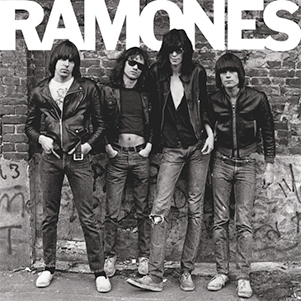
[30]The now iconic
front cover photograph of the band was taken by Roberta Bayley, a photographer for
Punk magazine.
[31] Punk, which was largely responsible for codifying the term for the scene emerging around CBGB, ran a cover story on the Ramones in its third issue, the same month as the record's release.
[32][28]
The Ramones' debut LP was greeted by rock critics with glowing reviews. The
Village Voice's
Robert Christgau wrote, "I love this record—love it—even though I know these boys flirt with images of brutality (Nazi especially).... For me, it blows everything else off the radio".
[33] In
Rolling Stone,
Paul Nelson described it as "constructed almost entirely of rhythm tracks of an exhilarating intensity rock & roll has not experienced since its earliest days." Characterizing the band as "authentic American primitives whose work has to be heard to be understood", he declared, "It is time popular music followed the other arts in honoring its primitives."
[34] Newsday's Wayne Robbins simply anointed the Ramones as "the best young rock 'n' roll band in the known universe."
[35]
However, despite Sire's high hopes for it,
[36] Ramones was not a commercial success, reaching only number 111 on the
Billboard album chart. The two singles issued from the album, "
Blitzkrieg Bop" and "I Wanna Be Your Boyfriend", failed to chart at all. At the band's first major performance outside of New York, a June date in
Youngstown, Ohio, approximately ten people showed up.
[37] It wasn't until they made a brief tour of England that they began to see the fruits of their labor; a performance at
The Roundhouse in London on July 4, 1976 (second-billed to the
Flamin' Groovies), organized by Linda Stein, was a resounding success.
[38] Their Roundhouse appearance and a club date the following night—where the band met members of the
Sex Pistols and
The Clash—helped galvanize the burgeoning UK punk rock scene.
[4] The Flamin' Groovies/Ramones double bill was successfully reprised at
The Roxy in Los Angeles the following month, fueling the punk scene there as well. The Ramones were becoming an increasingly popular live act—a Toronto performance in September energized yet another growing punk scene.
[39]
Their next two albums,
Leave Home and
Rocket to Russia, were released in 1977. Both were coproduced by Tommy and
Tony Bongiovi, the second cousin of
Jon Bon Jovi.
[40] Leave Home met with even less chart success than
Ramones, though it did include "Pinhead", which became one of the band's signature songs with its chanted refrain of "Gabba gabba hey!"
Rocket to Russia was the band's highest-charting album to date, reaching number 49 on the
Billboard 200.
[41] In
Rolling Stone, critic
Dave Marsh called it "the best American rock & roll of the year".
[42] The album also featured the first Ramones single to enter the
Billboard charts (albeit only as high as number 81): "
Sheena Is a Punk Rocker". The follow-up single, "Rockaway Beach", reached number 66—the highest any Ramones single would ever reach in America. On December 31, 1977, the Ramones recorded
It's Alive, a live concert double album, at the
Rainbow Theatre, London, which was released in April 1979 (the title is a reference to the
1974 horror film of the same name).
[43]
[edit]Recordings turn more pop: 1978–83
Tommy, tired of touring, left the band in early 1978. He continued as the Ramones' record producer under his birth name of Erdelyi. His position as drummer was filled by
Marc Bell, who had been a member of the early 1970s hard rock band
Dust,
Wayne County and the Backstreet Boys,
[44] and the pioneering punk group
Richard Hell & The Voidoids.
[45] Bell became Marky Ramone. Later that year, the band released their fourth studio album, and first with Marky,
Road to Ruin. The album, co-produced by Tommy with
Ed Stasium, included some new sounds such as acoustic guitar, several ballads, and the band's first two recorded songs longer than three minutes. It failed to reach the
Billboard Top 100. However, "
I Wanna Be Sedated", which appeared both on the album and as a single, would become one of the band's best-known songs.
[46] The artwork on the album's cover was done by
Punk magazine cofounder
John Holmstrom.
[47]
After the band's movie debut in
Roger Corman's
Rock 'n' Roll High School (1979), renowned producer
Phil Spector became interested in the Ramones and produced their 1980 album
End of the Century. During the recording sessions in Los Angeles, Spector held Dee Dee at gunpoint, forcing him to repeatedly play a riff.
[48] Though it was to be the highest-charting album in the band's history—reaching number 44 in the United States and number 14 in Great Britain—Johnny made clear that he favored the band's more aggressive punk material: "
End of the Century was just watered-down Ramones. It's not the real Ramones."
[49] This stance was also conveyed by the title and track selection of the compilation album Johnny later oversaw,
Loud, Fast Ramones: Their Toughest Hits. Despite these reservations, Johnny did concede that some of Spector's work with the band had merit, saying "It really worked when he got to a slower song like '
Danny Says'—the production really worked tremendously. 'Rock 'N' Roll Radio' is really good. For the harder stuff, it didn't work as well."
[50] The syrupy, string-laden
Ronettes cover "
Baby, I Love You" released as a single, became the band's biggest hit in Great Britain, reaching number 8 on the charts.
[51]

Joey and Dee Dee Ramone in concert, 1983
Pleasant Dreams, the band's sixth album, was released in 1981. It continued the trend established by
End of the Century, taking the band further from the raw punk sound of its early records. As described by
Trouser Press, the album, produced by
Graham Gouldman of UK pop act
10cc, moved the Ramones "away from their pioneering minimalism into heavy metal territory".
[52] Johnny would contend in retrospect that this direction was a record company decision, a continued futile attempt to get airplay on American radio.
[1][50] While
Pleasant Dreams reached number 58 on the U.S. chart, its two singles failed to register at all.
[53]
Subterranean Jungle, produced by Ritchie Cordell and Glen Kolotkin, was released in 1983.
[54] According to
Trouser Press, it brought the band "back to where they once belonged: junky '60s pop adjusted for current tastes", which among other things meant "easing off the breakneck rhythm that was once Ramones dogma."
[52] Billy Rogers, who had performed with
Johnny Thunders and The Heartbreakers, played drums on the album's second single, a cover of
The Chambers Brothers' "
Time Has Come Today".
[55] Subterranean Jungle peaked at number 83 in the United States—it would be the last album by the band to crack the
Billboard Top 100.
[56][57]
[edit]Shuffling members: 1983–89
After the release of
Subterranean Jungle, Marky was fired from the band due to his alcoholism.
[58] He was replaced by
Richard Reinhardt, who adopted the name
Richie Ramone. The first album the Ramones recorded with Richie was
Too Tough to Die in 1984, with Tommy Erdelyi and Ed Stasium returning as producers. The album marked a shift to something like the band's original sound. In the description of Allmusic's Stephen Thomas Erlewine, the "rhythms are back up to jackhammer speed and the songs are down to short, terse statements."
[59]
The band's main release of 1985 was the British single "
Bonzo Goes to Bitburg"; though it was available in the United States only as an import, it was played widely on American college radio.
[62] The song was written, primarily by Joey, in protest of
Ronald Reagan's visit to a German military cemetery where
SSmembers were buried.
[63] Retitled "My Brain Is Hanging Upside Down (Bonzo Goes to Bitburg)", the song appeared on the band's ninth studio album,
Animal Boy (1986). Produced by
Jean Beauvoir, formerly a member of the
Plasmatics, the album was characterized by a
Rolling Stone reviewer as "nonstop primal fuzz pop".
[64] Making it his pick for "album of the week",
New York Times critic
Jon Pareles wrote that the Ramones "speak up for outcasts and disturbed individuals".
[65]
The following year the band recorded their last album with Richie,
Halfway to Sanity, produced by
Daniel Rey. Richie left in August 1987, upset that after being in the band for four years, the other members would still not give him a share of the money they made selling T-shirts.
[66] Richie was replaced by
Clem Burke from
Blondie, which was disbanded at the time. According to Johnny, the performances with Burke—who adopted the name Elvis Ramone—were a disaster. He was fired after two performances because his drumming could not keep up with the rest of the band.
[66] Marky, now clean and sober, returned.
[20]
Dee Dee left the band after the recording of their eleventh studio album, 1989's
Brain Drain, co-produced by Beauvoir, Rey, and
Bill Laswell.
[67] He was replaced by
Christopher Joseph Ward (C.J. Ramone), who performed with the band until they disbanded. Dee Dee initially pursued a brief career as a rapper under the name Dee Dee King. He quickly returned to punk rock and formed several bands, in much the same vein as the Ramones, for whom he also continued to write songs.
[67]
[edit]Final years: 1990–96
After more than a decade and a half at Sire Records, the Ramones moved to a new label,
Radioactive Records. Their first album for the label was 1992's
Mondo Bizarro, which reunited them with producer Ed Stasium.
[68] Acid Eaters, consisting entirely of cover songs, came out the following year.
[69] In 1993 the Ramones were featured in the animated television series
The Simpsons, providing music and voices for animated versions of themselves in the episode "
Rosebud".
[70]
In 1995, the Ramones released
¡Adios Amigos!, their fourteenth studio album, and announced that they planned to disband if it was not successful.
[71][72] Its sales were unremarkable, garnering it just two weeks on the lower end of the
Billboard chart.
[73] The band spent late 1995 on what was promoted as a farewell tour. However, they accepted an offer to appear in the sixth
Lollapalooza festival, which toured around the United States during the following summer.
[74] After the Lollapalooza tour's conclusion, the Ramones played their final show on August 6, 1996, at the Palace in
Hollywood. A recording of the concert was later released on video and CD as
We're Outta Here! In addition to a reappearance by Dee Dee, the show featured several guests including
Motörhead's
Lemmy,
Pearl Jam's
Eddie Vedder,
Soundgarden's
Chris Cornell, and
Rancid's
Tim Armstrong and
Lars Frederiksen.
[3]
[edit]Aftermath and deaths

Marky Ramone at the 2009 premiere of the documentary
Burning Down the House: The Story of CBGB
On July 20, 1999, Dee Dee, Johnny, Joey, Tommy, Marky, and C.J. appeared together at the
Virgin Megastore in New York City for an autograph signing. This was the last occasion on which the original four members of the group appeared together. Joey, who had been diagnosed with lymphoma in 1995, died of the illness on April 15, 2001, in New York.
[4][75]
In 2002, the Ramones were inducted into the
Rock and Roll Hall of Fame, which specifically named Dee Dee, Johnny, Joey, Tommy, and Marky. At the ceremony, the surviving inductees spoke on behalf of the band. Tommy spoke first, saying how honored the band felt, but how much it would have meant for Joey. Johnny thanked the band's fans and blessed
George W. Bush and his presidency, Dee Dee humorously congratulated and thanked himself, while Marky thanked Tommy for influencing his drum style.
Green Day played "Teenage Lobotomy" and "
Blitzkrieg Bop" as a tribute, demonstrating the Ramones' continuing influence on later rock musicians. The ceremony was one of Dee Dee's last public appearances; on June 5, 2002, two months later, he was found at his Hollywood home, dead from a heroin overdose.
[5]
On November 30, 2003, New York City unveiled a sign designating East 2nd Street at the corner of Bowery as Joey Ramone Place. The singer lived on East 2nd for a time, and the sign is near the former Bowery site of CBGB.
[76] The documentary film
End of the Century: The Story of the Ramonescame out in 2004. Johnny, who had been privately battling prostate cancer, died on September 15, 2004, in Los Angeles, shortly after the film's release.
[6] On the same day as Johnny's death, the world's first Ramones Museum opened its doors to the public. Located in Berlin, Germany, the museum features more than 300 items of memorabilia, including a pair of stage-worn jeans from Johnny, a stage-worn glove from Joey, Marky's sneakers, and C.J.'s stage-worn bass strap.
[77]
The Ramones were inducted into the
Long Island Music Hall of Fame in 2007.
[78] That October saw the release of a DVD set containing concert footage of the band:
It's Alive 1974-1996 includes 118 songs from 33 performances over the span of the group's career.
[79] In February 2011, the group was honored with a
Grammy Lifetime Achievement Award. Drummers Tommy, Marky, and Richie attended the ceremony.
[12][13] Marky declared, "This is amazing. I never expected this. I'm sure Johnny, Joey, and Dee Dee would never have expected this."
[12] Richie noted that it was the first time ever that all three drummers were under the same roof, and mused that he couldn't "help thinking that [Joey] is watching us right now with a little smile on his face behind his rose-colored glasses."
[13]
[edit]Conflicts between members
Tensions between Joey and Johnny colored much of the Ramones' career. The pair were politically antagonistic, Joey being a
liberaland Johnny a
conservative. Their personalities also clashed: Johnny, who spent two years in military school, lived by a code of self-discipline,
[80] while Joey struggled with
obsessive-compulsive disorder.
[81] Johnny, who was fascinated by the
Nazis and
Adolf Hitler, would sometimes torment Joey (who was Jewish) with anti-Semitic remarks.
[82] In the early 1980s, Johnny "stole" Joey's girlfriend Linda, whom he later married. As a consequence, despite performing together for years afterward, Joey and Johnny stopped speaking to each other.
[6] Johnny did not call Joey before the latter's death in 2001, but said in the documentary
End of the Century that he was depressed for "the whole week" after the singer died.
[66]
Aside from this central conflict, Dee Dee's
bipolar disorder and repeated relapses into drug addiction also caused significant strains.
[83]Tommy left the band partly in reaction to being "physically threatened by Johnny, treated with contempt by Dee Dee, and all but ignored by Joey".
[82] As new members joined, payment methods and image representation became matters of serious dispute.
[84] In 1997, Marky and Joey got into a fight about their respective drinking habits on the
Howard Stern radio show.
[85]
[edit]Musical style
The Ramones' loud, fast, straightforward musical style was influenced by
pop music that the band members grew up listening to in the 1950s and 1960s, including classic rock groups such as
The Beach Boys,
The Beatles,
The Kinks, and
The Rolling Stones;
bubblegum acts like the
1910 Fruitgum Company and
Ohio Express; and girl groups such as
The Ronettes and
The Shangri-Las. They also drew on the harder rock sound of
The Stooges and the
New York Dolls, both now known as seminal
protopunk bands.
[87] The Ramones' style was in part a reaction against the heavily produced, often bombastic music that dominated the pop charts in the 1970s. "We decided to start our own group because we were bored with everything we heard," Joey once explained. "In 1974 everything was tenth-generation
Led Zeppelin, tenth-generation
Elton John, or overproduced, or just junk. Everything was long jams, long guitar solos.... We missed music like it used to be."
[88] Ira Robbins and Scott Isler of
Trouser Pressdescribe the result:
With just four chords and one manic tempo, New York's Ramones blasted open the clogged arteries of mid-'70s rock, reanimating the music. Their genius was to recapture the short/simple aesthetic from which pop had strayed, adding a caustic sense of trash-culture humor and minimalist rhythm guitar sound.
[89]
On stage, the band adopted a focused approach directly intended to increase the audience's concert experience. Johnny's instructions to C.J. when preparing for his first live performances with the group were to play facing the audience, to stand with the bass slung low between spread legs, and to walk forward to the front of stage at the same time as he did. Johnny was not a fan of guitarists who performed facing their drummer, amplifier, or other band members.
[92]
[edit]Visual imagery
The Ramones' art and visual imagery complemented the themes of their music and performance. The band members adopted a uniform look of long hair, leather jackets, t-shirts, torn jeans, and sneakers. This fashion emphasized minimalism, which was a powerful influence on the New York punk scene of the 1970s and reflected the band's short, simple songs.
[93] Tommy Ramone recalled that, both musically and visually, "we were influenced by comic books, movies, the
Andy Warhol scene, and avant-garde films. I was a big
Mad Magazine fan myself."
[93]
The band's logo was created by New York City artist Arturo Vega, a longtime friend who had allowed Joey and Dee Dee to move into his loft.
[94] Vega produced the band's t-shirts, their main source of income, basing most of the images on a black-and-white self-portrait photograph he had taken of his American bald eagle belt buckle which had appeared on the back sleeve of the Ramones' first album.
[95] He was inspired to create the band's logo after a trip to
Washington, D.C.:
I saw them as the ultimate all-American band. To me, they reflected the American character in general—an almost childish innocent aggression.... I thought, 'The Great Seal of the President of the United States' would be perfect for the Ramones, with the eagle holding arrows—to symbolize strength and the aggression that would be used against whomever dares to attack us—and an olive branch, offered to those who want to be friendly. But we decided to change it a little bit. Instead of the olive branch, we had an apple tree branch, since the Ramones were American as apple pie. And since Johnny was such a baseball fanatic, we had the eagle hold a baseball bat instead of the [Great Seal]'s arrows.
[95]
The scroll in the eagle's beak originally read "Look out below", but this was soon changed to "Hey ho let's go" after the opening lyrics of the band's first single, "
Blitzkrieg Bop". The arrowheads on the shield came from a design on a polyester shirt Vega had bought. The name "Ramones" was spelled out in block capitals above the logo using plastic stick-on letters.
[23] Where the presidential emblem read "Seal of the President of the United States" clockwise in the border around the eagle, Vega instead placed the
pseudonyms of the four band members: Johnny, Joey, Dee Dee, and Tommy. Over the years the names in the border would change as the band's lineup fluctuated.
[96]
[edit]Influence

Johnny Ramone in concert, 1977
The Ramones had a broad and lasting influence on the development of
popular music. Music historian
Jon Savage writes of their debut album that "it remains one of the few records that changed pop forever."
[97] As described by
Allmusic critic
Stephen Thomas Erlewine, "The band's first four albums set the blueprint for punk, especially American punk and hardcore, for the next two decades."
[98]Trouser Press's Robbins and Isler similarly write that the Ramones "not only spearheaded the original new wave/punk movement, but also drew the blueprint for subsequent hardcore punk bands".
[89] Punk journalist Phil Strongman writes, "In purely
musical terms, The Ramones, in attempting to re-create the excitement of pre-Dolby rock, were to cast a huge shadow—they had fused a blueprint for much of the indie future."
[24] Writing for
Slate in 2001,
Douglas Wolk described the Ramones as "easily the most influential group of the last 30 years."
[99]
The Ramones' debut album had an outsized effect relative to its modest sales. According to
Tony James, a member of several seminal British punk bands, "Everybody went up three gears the day they got that first Ramones album. Punk rock—that rama-lama super fast stuff—is totally down to the Ramones. Bands were just playing in an
MC5 groove until then."
[100] The Ramones' two July 1976 shows, like their debut album, are seen as having a significant impact on the style of many of the newly formed British punk acts—as one observer put it, "instantly nearly every band speeded up".
[101]The Ramones' first British concert, at London's Roundhouse concert hall, was held on July 4, 1976, the
United States Bicentennial. The
Sex Pistols were playing in
Sheffield that evening, supported by
The Clash, making their public debut. The next night, members of both bands attended the Ramones' gig at the Dingwall's club. Ramones manager Danny Fields recalls a conversation between Johnny Ramone and Clash bassist
Paul Simonon (which he mislocates at the Roundhouse): "Johnny asked him, 'What do you do? Are you in a band?' Paul said, 'Well, we just rehearse. We call ourselves the Clash but we're not good enough.' Johnny said, 'Wait till you see us—we stink, we're lousy, we can't play. Just get out there and do it.'"
[102] Another band whose members saw the Ramones perform,
The Damned, played their first show two days later. The central
fanzine of the early UK punk scene,
Sniffin' Glue, was named after the song "Now I Wanna Sniff Some Glue", which appeared on the debut LP.
[103]
Ramones concerts and recordings influenced many musicians central to the development of
California punk as well, including
Greg Ginn of
Black Flag,
[104] Jello Biafra of the
Dead Kennedys,
[105] Mike Ness of
Social Distortion,
[106] Brett Gurewitz of
Bad Religion,
[107]and members of the
Descendents.
[108] Canada's first major punk scenes—in Toronto and in
British Columbia's
Victoria and Vancouver—were also heavily influenced by the Ramones.
[39][109] In the late 1970s, many bands emerged with musical styles deeply indebted to the band's. There were
The Lurkers from England,
[110] The Undertones from Ireland,
[111] Teenage Head from Canada,
[112] and
The Zeros[113] and
The Dickies[114] from southern California. The seminal hardcore band
Bad Brains took its name from a Ramones song.
[115] The
Riverdales, made up of former members of Screeching Weasel, have emulated the sound of the Ramones throughout their career.
[116] Green Day frontman
Billie Joe Armstrong named his son Joey in homage to Joey Ramone, and drummer
Tré Coolnamed his daughter Ramona.
[117]
[edit]Tribute albums
In April 2009,
Spin writer Mark Pringle observed that the Ramones had to date "inspired a jaw-dropping 48 (at least!) full-length tribute records."
[124] The first Ramones tribute album featuring multiple performers was released in 1991:
Gabba Gabba Hey: A Tribute to the Ramones includes tracks by such acts as
The Flesh Eaters,
L7,
Mojo Nixon, and Bad Religion.
[123] In 2001, Dee Dee made a guest appearance on one track of
Ramones Maniacs, a multi-artist cover of the entire
Ramones Mania compilation album.
The Song Ramones the Same, which came out the following year, includes performances by
The Dictators, who were part of the early New York punk scene, and
Wayne Kramer, guitarist for the influential protopunk band
MC5.
We're a Happy Family: A Tribute to Ramones, released in 2003, features performers such as Green Day, Metallica,
Kiss,
The Offspring,
Red Hot Chili Peppers,
U2, and
Rob Zombie (who also did the album cover artwork).
[125]
Punk bands such as
Screeching Weasel,
The Vindictives,
The Queers,
The Mr. T Experience,
Boris the Sprinkler,
Beatnik Termites, Tip Toppers,
Jon Cougar Concentration Camp, and McRackins have recorded cover versions of entire Ramones albums—
Ramones,
Leave Home,
Rocket to Russia,
Road to Ruin,
End of the Century,
Pleasant Dreams,
Subterranean Jungle, and (two times)
Too Tough to Die, respectively.
[124] The Huntingtons'
File Under Ramones consists of Ramones covers from across the band's history.
[126]